The bus took about three hours to get to Lisbon mainly on the toll freeway. All the buses looked practically new and were spick and span inside and out. We took the metro from the bus station managing to successfully buy a day pass for all forms of transport, similar to the Octopus system in Hong Kong and the Oyster Card in London. It made it all much easier. We managed to find the hostel after one false start and found it overlooked one of the main squares, Rossio. We were on the third floor in a pleasant double room. The staff were always more than helpful and we felt fortunate to be in such a nice place to stay the one night.
 The view over Rossio Square from our room.
 Another view over the square form our window up to the Sao Jorge Castle in Alfama.
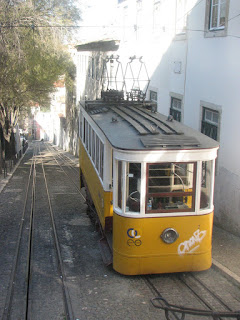
Lisbon is built on a series of hills and there can be lots of climbing up and down. To assist there are funiculars and elevators. This funicular took us from the level of the square up into the region called the Bairro Alto.
 Again we found narrow cobbled streets in this older part of the city. A good reason to leave the car at home.

 Another view of the castle from Bairro Alto.

Many of the buildings in Portugal are covered in tiles.

 The cathedral in Lisbon
 The Elevador de Santa Justa
This elevator was designed by a student of Gustav Eiffel to connect the lower and upper parts of the city.

Lisbon is famous for trams that they have preserved over the years. They manoeuvre there way along the narrow cobbled streets and serve the castle and also Belem , more on that later. The trams are well known as havens for pickpockets and there are notices to warn the unwary. One tram goes around a circular route up to the castle and back to the square.
 A Typical Lisbon tram
 The view over Lisbon from the Castle.
 A friendly peacock in the Castle grounds
There was a magical moment as we wandered around the castle grounds. We heard a guitar being played rather well somewhere out of sight. Not Musak but the real thing and we came across a gentleman playing Bach to a crowd of zero, until we arrived. There is no photograph because I took a short video with sound. I can email anyone interested to hear and see it. If you do, forgive the ending which is there because I couldn't find a way to stop the recording for a few seconds.
We took the tram back down to the city centre and ended a very pleasant day.
 Again we found narrow cobbled streets in this older part of the city. A good reason to leave the car at home.
 Another view of the castle from Bairro Alto.
The intricate design in the Sao Roque Church
Many of the buildings in Portugal are covered in tiles.

 The cathedral in Lisbon
 The Elevador de Santa Justa
This elevator was designed by a student of Gustav Eiffel to connect the lower and upper parts of the city.

Lisbon is famous for trams that they have preserved over the years. They manoeuvre there way along the narrow cobbled streets and serve the castle and also Belem , more on that later. The trams are well known as havens for pickpockets and there are notices to warn the unwary. One tram goes around a circular route up to the castle and back to the square.
 A Typical Lisbon tram
 The view over Lisbon from the Castle.
 A friendly peacock in the Castle grounds
There was a magical moment as we wandered around the castle grounds. We heard a guitar being played rather well somewhere out of sight. Not Musak but the real thing and we came across a gentleman playing Bach to a crowd of zero, until we arrived. There is no photograph because I took a short video with sound. I can email anyone interested to hear and see it. If you do, forgive the ending which is there because I couldn't find a way to stop the recording for a few seconds.
We took the tram back down to the city centre and ended a very pleasant day.


